What Is an AI Agent, Really?
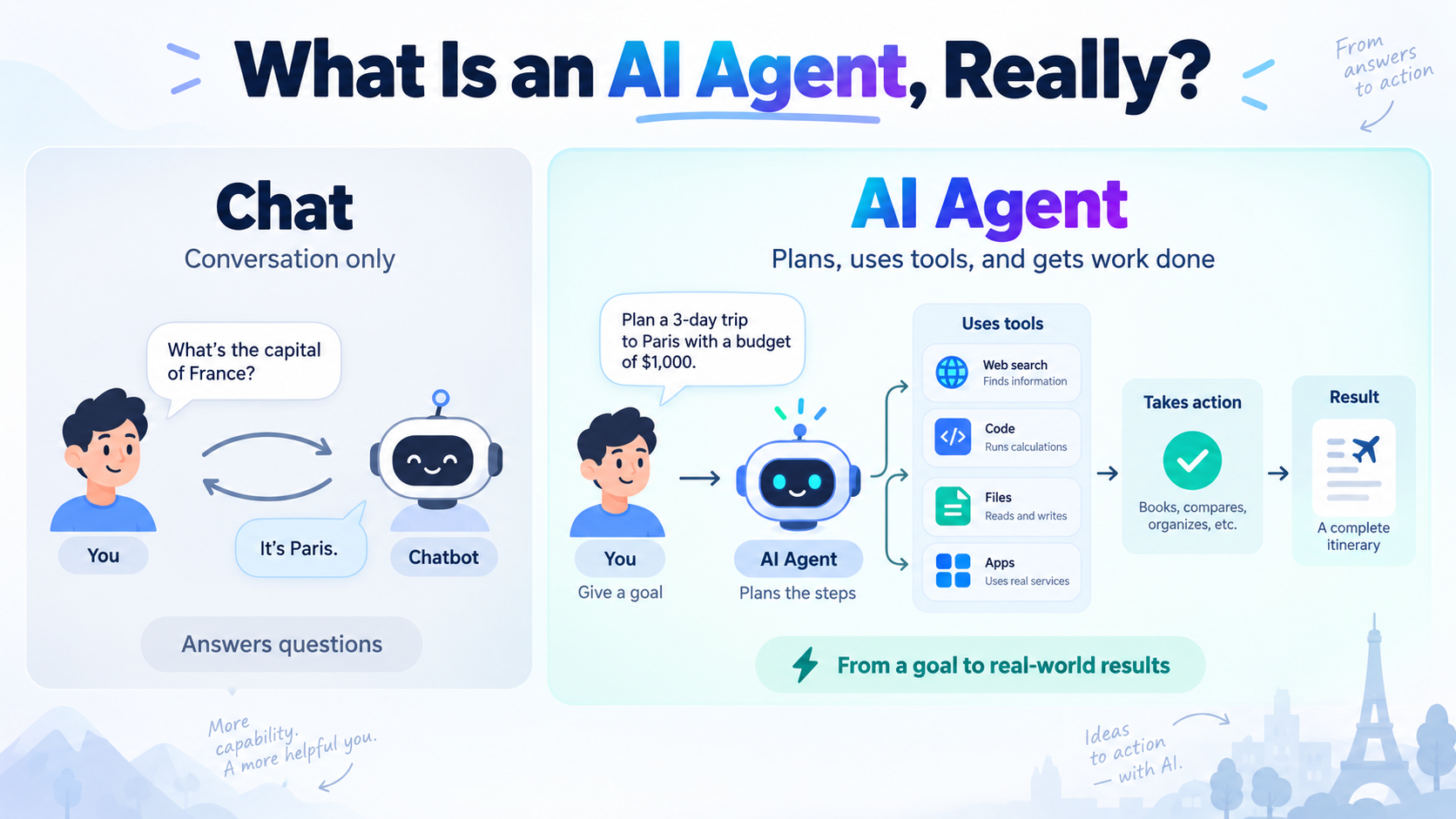
Everyone's building agents these days. And if someone isn't building one, chances are they're planning to. Ever since AI blew up, building things has gotten ridiculously easy, and now the shift is moving from chatbots to agents that can actually do things instead of just answering questions.
The Problem With Chatbots
Here's the thing about talking to ChatGPT, Claude, or any other LLM: you ask a question, it gives you a reply, and then... you're on your own. You still have to go implement everything yourself.
Say you're building an app and you hit a bug. You explain the problem, the model gives you a fix, and now you have to actually put it into your codebase, either by copy-pasting it (let's be honest, most of us just do this) or by carefully following the steps it laid out.
So, What's the Fix?
Yeah, you guessed it: an agent.
But what actually makes an agent different from a chatbot? And how does it work under the hood?
An Agent Is Basically Just a Big While Loop
Let's strip away the buzzwords, and an agent is just a loop that keeps running until your work is actually done.
Instead of you going back and forth with ChatGPT, copying its suggestions, testing them, and reporting back when they fail, an agent does that whole cycle for you. You give it a goal, and it keeps working, trying, checking, and retrying, until that goal is met. No more middleman. No more manual copy-paste. It just keeps going until it's done.
The Technical Definition
If you want something more formal to put in a slide deck or explain to your team, here are two solid definitions:
"An artificial intelligence (AI) agent is a system that autonomously performs tasks by designing workflows with available tools."
"An agent is a system that leverages an AI model to interact with its environment in order to achieve a user-defined objective. It combines reasoning, planning, and the execution of actions (often via external tools) to fulfill tasks."
Both boil down to the same idea: reasoning, planning, and taking action, on a loop, until the job is actually finished.
Now agents can be of different types, some of them are:
Simple reflex agents
Model based reflex agents
Goal based agents
Utility based agents
Learning based agents
All the above ones are different to each other and useful in their own way and use case. We will talk about them in detail in the next article. So stay tuned and follow to get the latest news from the AI world.